Wednesday, November 22, 2023

Thanksgiving Day Liturgy

 Liturgy for Private or Family Worship

(PDF Download)


Thanksgiving Day November 23, 2023


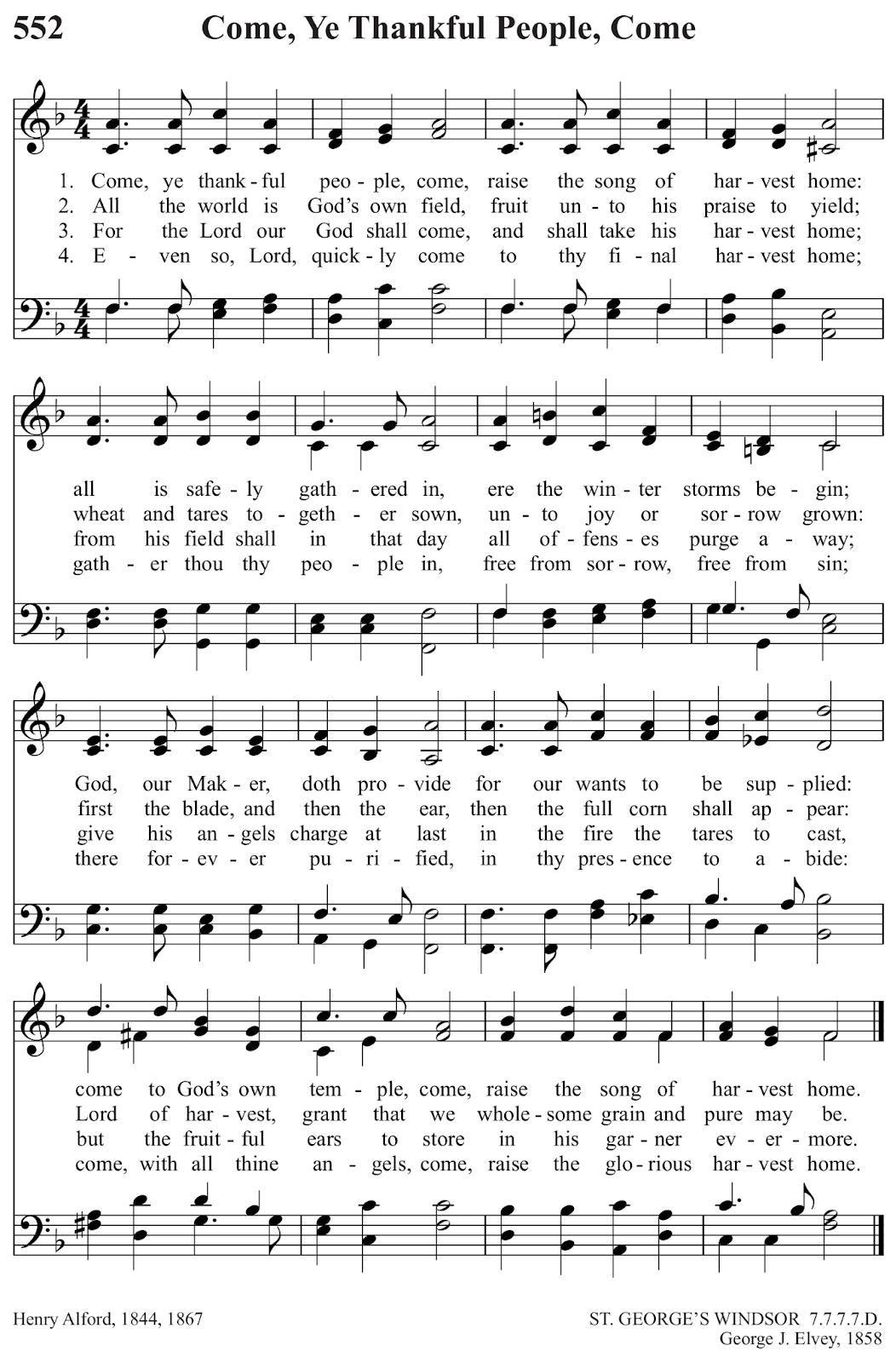
Gathering Hymn (Choose a gathering hymn, e.g. TPH #103C, #254, #552)

Responsive Psalm: Psalm 107:1-9

Leader: Oh, give thanks to the LORD, for He is good!

Household: For His mercy endures forever.

Let the redeemed of the LORD say so, Whom He has redeemed from the hand of the enemy,

And gathered out of the lands, from the east and the west, from the north and the south.

They wandered in the wilderness in a desolate way; They found no city to dwell in.

Hungry and thirsty, Their soul fainted in them.

Then they cried out to the Lord in their trouble, And He delivered them out of their distresses.

And He led them forth by the right way, That they might go to a city for a dwelling place.

Oh, that men would give thanks to the LORD for His goodness, And for His wonderful works to the children of men!

For He satisfies the longing soul, And fills the hungry soul with goodness.

Prayer of Thanksgiving (From the URCNA Book of Forms and Prayers)

Our Sovereign God, who created all things for Your pleasure and who gives to all life, breath, and every good thing, we thank You for our creation, our preservation, and all the blessings of this life. For rain and sunshine, in abundance and in lack, we acknowledge that our times are in Your hands. You supply all of Your creatures with Your good gifts, the just and the unjust alike. Nevertheless, we especially give You praise for the surpassing greatness of Your saving grace, which You have shown to us in Christ Jesus our Savior. For our election in Him before the foundation of the world, for our redemption by Him in His life, death, and resurrection, for our effectual calling, justification, sanctification, and all of the blessings of our union with Him, we give You our heartfelt thanks. And we look with great anticipation toward that day when You will raise us to life everlasting, glorified and confirmed in righteousness, so that we may sing Your praises without the defilement of our present weaknesses, distractions, and sins. As You have given us these gifts, we ask that You would give us grateful hearts, so that we may serve our neighbors in love. This we pray in the name of Jesus Christ our Savior, who taught us to pray, saying:

Corporate Prayer: The Lord’s Prayer

Our Father who art in heaven, Hallowed be thy name. 

Thy kingdom come. Thy will be done on earth, as it is in heaven. 

Give us this day our daily bread. And forgive us our debts, as we forgive our debtors. 

And lead us not into temptation, but deliver us from evil: 

For thine is the kingdom, and the power, and the glory, forever. Amen.

Responsive Psalm: Psalm 138 (Different readers may be chosen to lead each section in larger families)

Oh, give thanks to the LORD, for He is good! For His mercy endures forever.

Oh, give thanks to the God of gods! For His mercy endures forever.

Oh, give thanks to the Lord of lords! For His mercy endures forever:

Part 2: Creation

To Him who alone does great wonders, For His mercy endures forever;

To Him who by wisdom made the heavens, For His mercy endures forever;

To Him who laid out the earth above the waters, For His mercy endures forever;

To Him who made great lights, For His mercy endures forever—

The sun to rule by day, For His mercy endures forever;

The moon and stars to rule by night, For His mercy endures forever.

Part 3: Exodus

To Him who struck Egypt in their firstborn, For His mercy endures forever;

And brought out Israel from among them, For His mercy endures forever;

With a strong hand, and with an outstretched arm, For His mercy endures forever;

To Him who divided the Red Sea in two, For His mercy endures forever;

And made Israel pass through the midst of it, For His mercy endures forever;

But overthrew Pharaoh and his army in the Red Sea, For His mercy endures forever;

Part 4: Conquest

To Him who led His people through the wilderness, For His mercy endures forever;

To Him who struck down great kings, For His mercy endures forever;

And slew famous kings, For His mercy endures forever—

Sihon king of the Amorites, For His mercy endures forever;

And Og king of Bashan, For His mercy endures forever—

And gave their land as a heritage, For His mercy endures forever;

A heritage to Israel His servant, For His mercy endures forever.

Part 5: Providence

Who remembered us in our lowly state, For His mercy endures forever;

And rescued us from our enemies, For His mercy endures forever;

Who gives food to all flesh, For His mercy endures forever.

Oh, give thanks to the God of heaven! For His mercy endures forever.

Glory be to the Father, and to the Son, and to the Holy Ghost;
As it was in the beginning, is now, and ever shall be, world without end. Amen.

Collect

O MOST merciful Father, who hast blessed the labours of the husbandman in the returns of the fruits of the earth; We give thee humble and hearty thanks for this thy bounty; beseeching thee to continue thy loving-kindness to us, that our land may still yield her increase, to thy glory and our comfort; through Jesus Christ our Lord. Amen.

Scripture Reading: James 1:16-27

Do not be deceived, my beloved brethren. Every good gift and every perfect gift is from above, and comes down from the Father of lights, with whom there is no variation or shadow of turning. Of His own will He brought us forth by the word of truth, that we might be a kind of firstfruits of His creatures. So then, my beloved brethren, let every man be swift to hear, slow to speak, slow to wrath; for the wrath of man does not produce the righteousness of God.

Therefore lay aside all filthiness and overflow of wickedness, and receive with meekness the implanted word, which is able to save your souls. But be doers of the word, and not hearers only, deceiving yourselves. For if anyone is a hearer of the word and not a doer, he is like a man observing his natural face in a mirror; for he observes himself, goes away, and immediately forgets what kind of man he was. But he who looks into the perfect law of liberty and continues in it, and is not a forgetful hearer but a doer of the work, this one will be blessed in what he does.

If anyone among you thinks he is religious, and does not bridle his tongue but deceives his own heart, this one’s religion is useless. Pure and undefiled religion before God and the Father is this: to visit orphans and widows in their trouble, and to keep oneself unspotted from the world.

Scripture Reading: Matthew 6:25-34

“Therefore I say to you, do not worry about your life, what you will eat or what you will drink; nor about your body, what you will put on. Is not life more than food and the body more than clothing? Look at the birds of the air, for they neither sow nor reap nor gather into barns; yet your heavenly Father feeds them. Are you not of more value than they? Which of you by worrying can add one cubit to his stature?

“So why do you worry about clothing? Consider the lilies of the field, how they grow: they neither toil nor spin; and yet I say to you that even Solomon in all his glory was not arrayed like one of these. Now if God so clothes the grass of the field, which today is, and tomorrow is thrown into the oven, will He not much more clothe you, O you of little faith?

“Therefore do not worry, saying, ‘What shall we eat?’ or ‘What shall we drink?’ or ‘What shall we wear?’ For after all these things the Gentiles seek. For your heavenly Father knows that you need all these things. But seek first the kingdom of God and His righteousness, and all these things shall be added to you. Therefore do not worry about tomorrow, for tomorrow will worry about its own things. Sufficient for the day is its own trouble.”

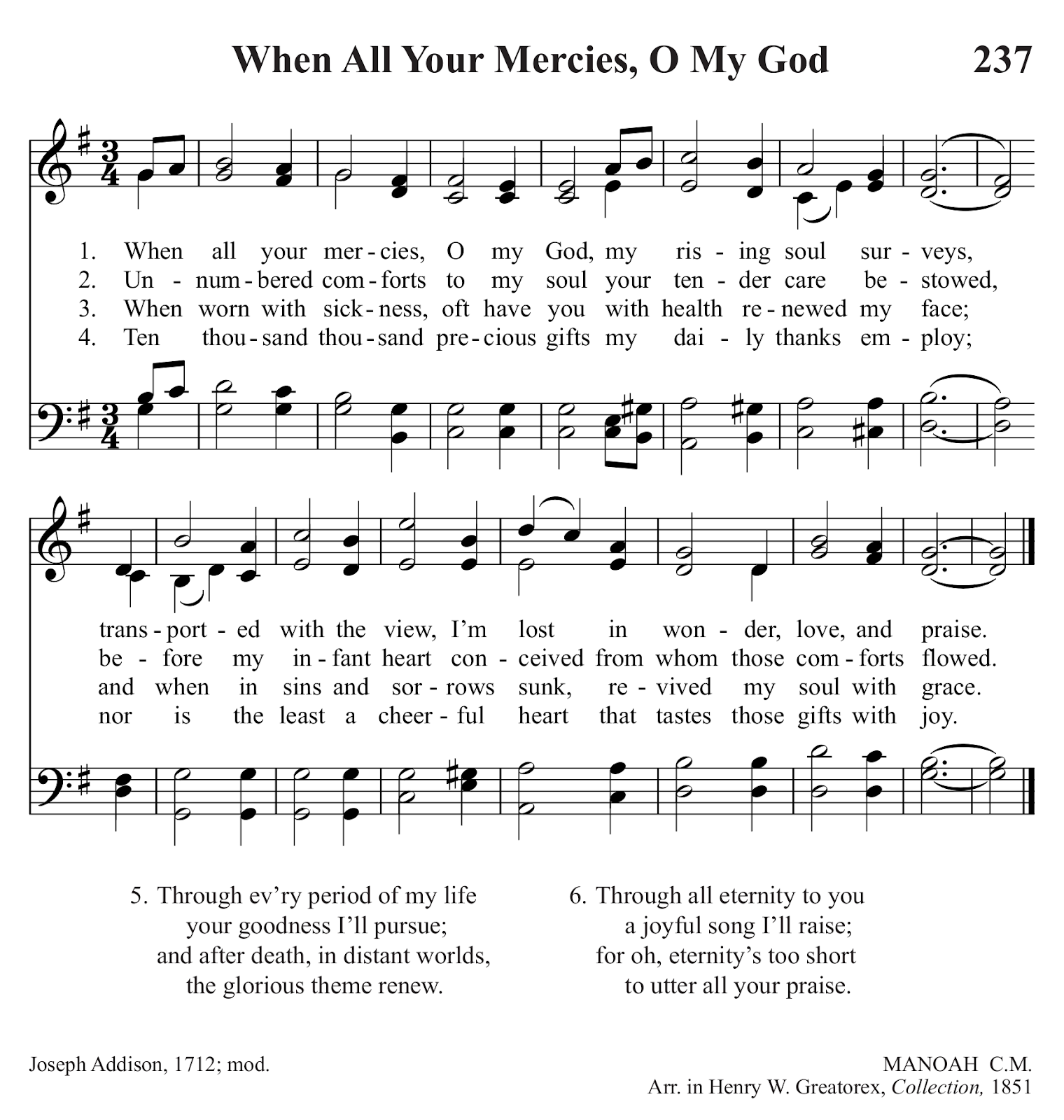
Hymn  (Choose a hymn, e.g. TPH #237 or O God of Earth and Altar)

Closing Blessing

May the LORD bless us, and keep us. May the LORD make his face to shine upon us, and be gracious unto us. May the LORD lift up his countenance upon us, and give us peace, both now and evermore.

Amen

Closing Praise: Doxology

Tuesday, November 14, 2023

The King is Calling

The King is calling. You have been summoned to appear in his courts. All of the saints will be there, though millions of them will not be visible to us. We will lift our voices, and heaven will thunder. Our voices may be small, but the Father hears each one. Prayer will ascend from the Church’s altar, rising like incense before the heavenly throne. The Lord will speak, pardoning our sins, assuring us of his love and acceptance, proclaiming and instructing us in his truth. His Table has been set with bread and wine, the emblems of his body and blood, visible words making the invisible Word tastable. We will feast in the midst of our foes, fearless because we know that those who are with us are more than those who are against us. Then God will bless us, laying his hands upon us, sending us forth to fill the world with the knowledge and glory of his power, love, and authority. We will lift our hands in praise and go on our way singing with hearts full of joy.


The Lord’s Day may seem very ordinary, but what is ordinary on the holy day is really quite extraordinary. It might be easy to take the routine for granted, but we must learn to see it with spiritual eyes. Put on the spectacles of the Scriptures—to borrow an analogy from Calvin—let the Spirit correct your vision. You are in the midst of angels. You are singing with Abel and Noah, Abraham and Moses, David and Elijah, Hannah and Mary and Rufus’s mom. We are communing with heavenly realities, more substantial than the insubstantial objects that we presently can see. That is not merely an ancient book being read; the Lord is speaking. The pastor may be saying the same things again, but he is only a dummy sitting in the Savior’s lap. The Shepherd is the ventriloquist. The sacraments may not operate magically, but everything else about the Lord’s Day is. This is the true power, the real conspiracy, the secret society that the storybooks can only imagine and caricature. We are not alone, and there is a plan for a foreign power to take over the world. He is not a usurper but the Redeemer, and he is coming to reclaim what is rightly his own.


Every Lord’s Day we go to heaven to be with the Lord. Most of the time we then return in order to carry on the work and battle here below. One day we will ascend and remain with the Lord, carried by angels to join Abraham and the saints who have fallen asleep before. We will await the final coming, the day of the Lord’s glory and earth’s redemption. Every Lord’s Day is a preparation and participation in that future, final hope. The King is summoning us. Come, and let us adore him. --JME

Saturday, November 4, 2023

Ordinary Lord's Days

Tomorrow is the Lord’s Day. It sometimes is hard to appreciate the present. Maybe that is because our attention tends to be fixated on crisis and chaos, the things that cause us anxiety, fear, or anger in the moment. It may be because we tend to remember the past more fondly, reviewing it with rose-colored glasses whether it really was as pleasant as we imagine in hindsight. Maybe we do not appreciate the present because we are always eager to get to the next big thing: another birthday, graduation, marriage, childbirth, promotion, vacation, retirement, or a better set of dentures.


The Lord’s Day is a day to appreciate every week. It doesn’t really matter what the sermon is about or what psalms and hymns the congregation sings or how well. It doesn’t really matter if Brother Talks-a-lot annoys you or Sister Indiscreet embarrasses everyone. The joy of the Lord’s Day does not depend on how “good” church seemed to be. A month from now you won’t remember this week’s sermon. (I flatter myself; it will probably be forgotten by Monday night.) You won’t remember how many psalms we sang or how off-key Pastor Joel’s rendition of the Doxology was this week. This will probably be like most other Sundays, forgettable, unremarkable, like almost every meal you’ve ever eaten in your life. But just like every one of those meals, each Sunday is contributing to your overall health. You may not remember much about the worship and teaching, but it will have, nonetheless, penetrated your heart, taken root in your soul, and worked graciously to make you more like your Savior and Lord.


The fact is the only Lord’s Days that stick out in our minds were either exceptionally bad or exceptionally good. You probably remember the Sunday you gave your life to Jesus. You may also remember most of the Sundays we had to call the fire department. But there are things about the Lord’s Day you will never forget. Seeing the joy of young children crashing into the church building, excited to come to church with their family and friends. Hearing their sweet voices sing the Doxology with sticky hands raised toward the ceiling. Watching old men and women totter into the building, coming to pray to the Savior they hope soon to see face to face. Feeling the surge of power as the congregation lifts its voice in triumphant song, knowing our voices are being magnified by heaven’s chorus and that the demons in darkness tremble as the Church Militant sounds. Experiencing gospel conviction under the preaching of the Word, being converted again as you hear for the millionth time the sweet words of the gospel. These are memories, experiences, and impressions that will long outlast our recollection of particular details of any given Sunday.


We put so much time, labor, and concentration into services, meals, laundry, and moments that will be forgotten almost as soon as they are done. This is how we will spend much of our lives. My children will forget almost every time I told them I love them, but I hope they will never forget that I do. You will forget most of the ways and days the Lord bestowed his love on you, but you won’t forget he loves you, because he will never forget you.


I hope tomorrow is a fairly ordinary Lord’s Day. There will certainly be special moments. We will welcome another member to our congregation. We will hear covenant children affirm their faith and come to the Lord’s Table for the first time. Hopefully we won’t have to call the fire department. But whether the day is memorable or not, it will be another meeting with God, another reception of the means of grace, another step on our journey of faith as we partake of and participate in the glory of God. Taste and see that the Lord is good. Come, and welcome to Jesus Christ. --JME

Simpler Sundays

Tomorrow is the Lord’s Day. Worship on Sundays is a lot of work. I grew up at a time and in churches that required very little in terms of preparation. Certain things had to be done, of course. The church building had to be cleaned, the communion bread had to be baked and the trays prepared, and depending on the season the heating and cooling units had to be turned on. But that was about it. The preacher prepared his sermon which might involve notes scribbled on one or two half sheets of paper. The song leader, who was not the preacher, picked out the hymns they would sing. A couple of men in the congregation would lead prayer. The hardest workers prior to Sunday were probably the children’s Sunday School teachers. While the adult Sunday School teachers only had to make sure they had filled in the blanks in their lesson books, teachers in the children’s classes spent hours with construction paper, popsicle sticks, and coloring pages which were the secret tools for catechizing Christian kids.


No one had a “worship order.” The song numbers were on the wooden board at the front of the auditorium. Everyone knew the order anyway. Announcements, opening hymn, prayer, two more hymns, sermon, or Lord’s Supper if you were one of those churches that did it first so that people going on vacation could leave early and not have to wait through the sermon. Then came the invitation in case anyone needed to get saved or be restored to the church, then the Lord’s Supper (if you were the other kind of church that didn’t care about members going on vacation), then another hymn, then the closing prayer. Why would anyone write it down? It was the same every week. Besides, those churches didn’t believe in having a liturgy. It wouldn’t be biblical.


When I became a preacher I became responsible for the weekly bulletin. It didn’t have the worship order on it. Usually it consisted of announcements, prayer requests for people who were falling apart, an edifying article on why the denominations were going to Hell, and a Bible WordSearch or trivia question. Some weeks I had to copy and fold thirty or more of those bulletins.


I never had text messages, emails, or internet news articles to process on the Lord’s Day. Al Gore had already invented the Internet, but it had not yet enslaved the entire human race and turned our brains to oatmeal. I began pastoring a few years before the September 11th attacks, so when that happened, things changed a bit, but before the War on Terror, the most urgent events to discuss on Sundays were the latest Alabama and Auburn football games, SEC recruiting updates, and the Braves’ pennant prospects.


I don’t have to tell you that Sundays at ROPC are a wee bit more complicated, and not because we have a set liturgy. If anything, the stability of our liturgy ought to make preparation considerably simpler. But the sheer volume of separate projects to prepare, handouts to be printed, coordination of various kinds, and number of attendees makes getting ready for each Sunday a marathon run at the speed of a sprint. Most churches would handle this with something called staff, and not the “rod and” kind, but we are more spiritual than most churches and so we tend to rely simply on providence… and lots of coffee.


I think I am becoming a grumpy old man. (My wife and children are probably asking, “What do you mean becoming?!) Ecclesiastes warns us not to ask why the former days were so much better than these (7:10). The truth is, they weren’t, and even if in some ways they were, dwelling on it is not the path to wisdom. We are constantly tempted to be ungrateful for the present and be naive about the past. But at the risk of erring by reminiscence, perhaps we can admit that a slower pace and simpler way of life was not necessarily a bad thing. It’s good to pull out the china and spend two days preparing for a lavish Thanksgiving feast, but it’s not wrong simply to gather with family and friends one afternoon to eat PB and Banana sandwiches on paper plates or to have a spontaneous outing for slushies at the drive through. That can, and should, be thanksgiving too.


Sundays are not about production, and even if we want to do our work as worshipers in a professional way, we are not professionals. We are God’s people, his children, a people of prayer, sheep responding to our Shepherd’s call. We are a family. Some enter the assembly bouncing and others come broken and bleeding (having learned the hard way that they do not bounce anymore). Some come rejoicing and others weeping. But the point is that we have come to meet with God. He is coming to meet us. That is what the Lord’s Days are about: cleansing, consecration, and communion; confession and consolation; supplication and celebration. It doesn’t matter that our bulletin doesn’t have a Bible WordSearch or that there are too many lemon donuts and too little coffee. We endure these hardships because of the greater joy of why we’re here.


We may live in a modern world, but we should come to worship in an ancient way. Sunday gatherings are not an entertainment production. They are a divine encounter, a holy sacrifice, and a happy reunion of the family of God. Don’t ask why the former days were better than these, but remember the lessons of an earlier and simpler time. God is summoning us to worship. So come simply, and let us adore him. --JME

Saturday, October 14, 2023

Liturgical Legos and Gospel Logic

Liturgy on the Lord’s Day, if biblically formed and properly ordered, is an experiential participation in the gospel. I have been in many worship services where every element of worship was biblical and appropriate but the arrangement of the whole was like a box of Legos, disconnected and subject to arrangement into whatever shape the pastor may have desired. This is not the way worship was structured in the Bible.


When an Israelite brought his sacrifice to the Tabernacle or Temple, there was a gospel-logic to the sequence of events. First he laid his hands on the animal, confessing his sins and identifying with his sacrifice who would die in his place. The sin offering would be followed by an ascension offering, often translated as the burnt offering because the entire animal was consumed in the fire. Here the worshiper’s consecration to God was visibly enacted. The sacrifice stood in the man of Israel’s place on that altar. It was not only the bull that was being given to God but the believer who brought him. Present your bodies as living sacrifices, holy, acceptable to God, which is your reasonable worship. Finally a peace offering would be presented. In this sacrifice, a token portion of the animal was placed on the altar, but the greater part was given to the worshiper and his family to be eaten in the presence of the Lord. The worshiper, having been cleansed and consecrated, now enjoyed communion with the God who had made peace with him.


This same pattern is seen repeatedly in the OT in corporate gatherings and covenant renewal. It is the same order found in sections of the NT: cleansing, consecration, and communion. This is how the Church ought to come before God. We confess our sins and receive his pardon. We sit under the reading and teaching of his Word as we are made holy by the God who declared us to be so by the righteousness of his Son. Then we celebrate our redemption and reconciliation. Thou preparest a table before me in the presence of mine enemies. The body of the Lamb whose blood marks the doorpost of our house is now eaten by the worshiper and his family who are hidden safely inside. We know the Destroyer will not visit this house, because it is God’s house, and he sees the blood and remembers his promise to his people.


There are many reasons to use this pattern in the Church’s weekly worship, first and foremost because it is the way we find worship structured in the Word of God. I am not claiming that all churches who do not are in explicit disobedience or unfaithful to the Lord. But this pattern is biblical, pervasive, and purposeful. It has a gospel-logic, so that no matter the subject of the sermon, no matter how well or poorly the congregation sings, no matter the clarity of the Scripture readings, the congregation will be evangelized every week, led once again through the gospel that first called them to Christ, cleansed, comforted, and confirmed in the grace that is theirs in the Lord Jesus.


In many churches, the success and value of the service depends entirely on one or two features. “How was church today?” means was the sermon interesting and powerful, was the singing loud and beautiful, were there enough Boston Creme donuts or did we have too many of the Lemon Filled ones? When worship is arranged by a biblical model of covenant renewal, these individual pieces are placed in the larger context of the Church’s experience of grace in the presence of God. No longer does the service seem to depend on the man up front or the congregation’s participation. “How was church today?” God met with us, forgave us, assured us of his love, encouraged us in our faith, and reminded us that he remembers his promise to save us. We experienced the goodness of our Lord again in the gospel. Thanks be to God. --JME

Feeding the Sheep

One of the greatest challenges in weekly preaching is remembering that you must meet your audience where they are and help them in their daily walk with Christ. The typical Reformed pastor spends a lot of time with books, reading old volumes of theology and sermons written by men who have been dead for many years, sometimes centuries. He may also spend time online or actively corresponding with other men about current theological controversies and the latest issue which has been designated the true test of orthodoxy. But when it comes time to write his weekly sermon(s), if he is a good pastor, he must remember that he was sent by Christ to shepherd a particular flock of sheep. He is not pastoring an audience on YouTube. He is not enlightening the broader presbytery by the brilliance of his exposition or saving his denomination by the power of his elocution. He is a shepherd sent to lead, feed, water, and protect particular sheep, and most of those sheep have very different priorities than their theologically attuned pastor.


Reformed churches are, rightly, critical of evangelicalish churches where the sermon is always something like Seven Ways to Have a Better Marriage or What Taylor Swift’s Eras Tour Can Teach Us About Loving Jesus. Such preaching neither edifies saints nor points the unbeliever to Jesus Christ. But Reformed churches can easily make an equal, if seemingly opposite, error by concentrating on theological minutiae or the kinds of issues that, while important, do not truly serve the needs of the sheep struggling to follow Christ in the world today. This is how we get multi-year sermon series on “the error of the Federal Vision” or multiple lessons on “the implications of the 16th century Council of Trent for assessing the Church in Rome.” Some Reformed churches are so intent on preaching justification, and so averse to anything that seems like moralizing, that they cannot bring themselves to preach the third use of the Law. I have visited churches where the preaching was solid and Christ-centered and utterly devoid of any practical application.


There is a balance. The sheep need to be warned of errors and taught how to think biblically and christianly. The saints may not always recognize why a certain issue is important or how a particular topic may be valuable to them. Faithful preaching involves laying one brick at a time, week by week, year after year, hoping and praying that the Lord will use it to build his Temple and that it will not look like the tower in a game of Jenga on round twelve.


Biblical preaching is practical, and practical preaching in Christ’s churches should always be first and foremost biblical. That is why the Reformed churches’ commitment to systematic exposition of Bible books, as a general model, is so helpful and markedly superior to the preaching in many other traditions. If the pastor is faithfully preaching his way through Bible books, the Holy Spirit will get the nutrients to the sheep that they need, whether the pastor realizes what they are or not.


Good preaching is not just teaching what to do this week or how to think about a single issue. It is forming us in the likeness of Christ. It is a means of grace used by the Spirit to chip away the remaining sinfulness and carve us more and more in the form of Jesus. It is training discernment, teaching us not only how to view one thing but learning how to look at everything through the lens of creation and covenant, Scripture and the life of our Savior, cross and future crown. Faithful preaching is an exercise in forming the christian mind, bit by bit, step by step, from the youngest child in the congregation to the oldest saint waiting on the doorstep of eternity to see Christ for the first time. --JME

Tuesday, October 10, 2023

Making Excuses for Evil

Two people groups are at war in the Middle East. The conflict is longstanding and complicated by multiple generations, and centuries, of political, social, and religious history. Grievances are claimed by both sides. Arguments are made for the righteousness of each one’s cause and for the injustice of the other.


One of these groups is an organized nation. The other is an acknowledged terrorist organization. One side allows members of the opposing ethnic and religious group to live in their society, participate in their economy, and even serve in their parliament and government positions. The other is openly committed to eradicating their opponents from the earth, not just destroying the nation, but annihilating the people as an ethnic group. One side is charged with the “sin” of occupation and colonization. The other explicitly states their commitment to genocide.


Whenever there is war, there will be collateral damage, innocent casualties, and various atrocities. Even in the most just war, prosecuted according to the strictest standards of justice and martial ethics, innocent men, women, and children will be harmed, intentionally or unintentionally. In this conflict, one side works to limit collateral damage and casualties and is committed to punishing evil and injustice within its own ranks. The other side films the atrocities its soldiers commit and publishes them on official social media platforms, celebrating the horrors which are that organization’s ordinary means of warfare, not exceptional or regrettable departures from the standard.


Hamas is deliberately, systematically, and openly making war on a civilian population. Women raped publicly and repeatedly, children decapitated, civilians taken as hostages, bodies mutilated, unarmed communities burned. How do we know these things are happening? Because Hamas films them, publishes them, celebrates them. These are not aberrant and regrettable actions set within a larger program of just war. These are war crimes, hundreds of them, terrorism and barbarity adopted as official strategy.


How did America get to the point when legislators and leaders of executive agencies would be so morally bankrupt as to offer sympathy, “context,” and patience for such evil? “Hamas’s actions are unacceptable, but we must remember the larger context,” or so we are told. “Yes, decapitating babies and serial raping and sodomizing women is bad, but Israel should suspend all military action and enter into peace negotiations.” Really? These are the same people who lecture us about blaming the victim when it comes to sexual assault. If they didn’t have double standards, they wouldn’t have any standards at all. Similarly, how did the American Church get to the point that we would tolerate such moral equivocation from its leaders? Pastors who hem around the edges of this issue demonstrate that they have no moral discernment.


You do not have to be a Zionist, neo-con, or dispensationalist to support Israel in the war with Hamas. You simply have to have a brain, a functioning moral conscience, a soul that is not entirely hellbent and darkened by self-deception and demonic lies. The State of Israel is largely secular, and even its religious population overwhelmingly rejects Jesus of Nazareth as the Messiah. But  the conduct and stated mission of Hamas is explicitly, indefensibly evil. There are no mitigating circumstances, no excuses, no room for context, nuance, or negotiation. The Arab-Israeli conflict may be complicated. The Israel-Hamas war is not.


This is not a political disagreement. It is evil incarnate. Evil must be recognized for what it is and eradicated. Every leader, soldier, and financial supporter of Hamas should be identified, hunted down, and executed. Every apologist and sympathizer for Hamas should be ashamed, publicly denounced, and removed from any position of government power and influence. This is what is right. It is what is just and necessary to protect the citizens of Israel, both Jews and Arabs. And it is what is necessary for the well-being of the Palestinian people. Their hope for peace and place in the Middle East requires the destruction of Hamas and terror organizations that practice violence in the name of freedom. –JME


See also: "Thinking Christianly about Israel"